




The European Federation of Centres of Research and Information on Cults and Sects (FECRIS), a French association founded in 1994, has long faced criticism for its role in stigmatizing religious minorities. In July 2020, the United States Commission on International Religious Freedom (USCIRF), an independent, bipartisan federal body, explicitly accused it of spreading negative propaganda against religious minorities, particularly at the Organization for Security and Co-operation in Europe (OSCE).
The American report also denounced its relations with Alexander Dvorkin, a Russian anti-cult leader close to the Moscow Patriarchate and to the institutions responsible for controlling religious organizations in Russia.
Yet FECRIS has received funding from the French state since the early 2000s, which, according to USCIRF in 2020, still accounted for most of its resources. An official response from the Prime Minister published by the French Senate confirms that it received €18,000 in public subsidies in 2025.
After Russia’s invasion of Ukraine in February 2022, FECRIS’s ties to networks in Moscow became particularly embarrassing. In September that year, CAP Liberté de Conscience initiated proceedings in France seeking the federation’s dissolution, denouncing, among other things, its relationships with Russian actors involved in religious repression and Kremlin propaganda.
On March 24, 2023, cornered by the legal proceedings, FECRIS finally decided to exclude its Russian member associations and their members, including Alexander Dvorkin, a former vice-president and board member re-elected in September 2021.
The federation could now present itself as having broken with Moscow (although it made no announcement on the subject and never publicly distanced itself). But, as Religactu had already examined in August 2025, excluding its Russian members had not necessarily dismantled the networks that connected them with their European counterparts.
A meeting held in Liège in October 2026 provides particularly revealing new evidence.
The Liège Meeting
On October 25 and 26, 2026, FECRIS held a conference in Liège with its Belgian association AVISO, entitled “FECRIS and Its Member Associations: Safeguarding Democracy.”
Three Serbian representatives of the Centre for Anthropological Studies (CAS), a Belgrade association that has belonged to FECRIS since 2007, took part: Sandra Knežević, an anthropologist of religion; Slobodan Spasić, acting chairman of the board of directors; and Andrej Protić, a collaborator of the centre.
Their attendance is documented in a report published by the Serbian Orthodox Church’s missionary department, signed by Sandra Knežević.
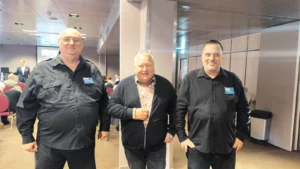
The report even describes CAS as an “official delegation of the Republic of Serbia,” although it is legally an association. The basis for any government mandate is not specified.
The Serbian association announced that it had opened discussions with the Austrian federal office responsible for cult-related matters, notably to develop mechanisms for monitoring the financing of religious or spiritual movements through NGOs and humanitarian funds.
It also intends to play a much more active role in future FECRIS conferences, including the one planned for Toulouse in October 2027.
This interest in the Serbs is not new. In his 2024 activity report, André Frédéric expressly welcomed the renewal of ties with the Polish, Bulgarian, Serbian and German associations.
Following the exclusion of its Russian members, FECRIS therefore sought to strengthen its relations with partners in Eastern Europe. But who exactly are its Serbian representatives?
Close Ties with the Serbian and Russian Orthodox Churches
CAS presents itself as a research centre specializing in activities described as sectarian. Yet several of its leaders are directly involved in a confessional organization: the apologetics section of the missionary department of the Serbian Orthodox Church.
Andrej Protić and Slobodan Spasić are permanent collaborators of that section. Zoran Luković, a former CAS leader and a longstanding figure in the Serbian anti-cult movement, coordinates the section and its publishing portal, Apologetsko slovo.
Apologetics is a religious activity aimed at defending a doctrine and responding to beliefs considered mistaken. Its objective is therefore explicitly confessional.
On November 26, 2025, Protić, Spasić and Luković trained Orthodox religious-education teachers in the fight against “cults,” as part of an initiative of the missionary department.
In 2026, in a study devoted to Satanism, Protić personally affirmed this orientation. He distinguished secular approaches to anti-cult work from Christian apologetic approaches, placing Luković, Spasić, himself and Alexander Dvorkin in the latter category.
These leaders’ public positions confirm their particular conception of religious freedom.
In a publication from June 2025, they explicitly advocated moving the treatment of groups described as cults from the field of human rights to that of extremism and radicalization. The text attributes this proposal to Protić, Spasić and Luković.
The Church portal also publishes warnings against identifiable communities, including Jehovah’s Witnesses and several spiritual movements of Indian origin.
Sandra Knežević, meanwhile, holds responsibilities in the Serbian Orthodox Church’s external mission. She heads a Chinese-language missionary programme and devoted her doctorate to the Russian Orthodox Church’s mission in Shanghai, where she spent ten years recently. Her programme notably uses Russian liturgical resources.
These activities take place against the backdrop of a Serbian Orthodox Church maintaining privileged political and religious relations with Moscow.
On April 22, 2025, its patriarch Porfirije met Vladimir Putin at the Kremlin alongside Patriarch Kirill. The Serbian Orthodox Church’s official statement indicates that he praised the Russian president’s role in defending Christian values and expressed a wish to strengthen cooperation between the two Churches.
The paradox is clear: a French federation funded by a secular state counts among its members an association whose leaders openly pursue a mission of doctrinal defence for a Church closely tied to the Moscow Patriarchate.
Alexander Dvorkin: The Expelled Figure Who Remains a Reference Point
Relations between CAS and Alexander Dvorkin go back decades.
In May 2009, Andrej Protić and Zoran Luković participated in a FECRIS conference in St Petersburg, organized with the Russian Saint Irenaeus of Lyons Centre, headed by Dvorkin. Alexander Konovalov, then Russia’s minister of justice, was also present at Dvorkin’s personal invitation. Dvorkin had been his teacher at St Tikhon’s Orthodox University; Konovalov had recently brought him onto his ministry’s Council for Religious Expert Assessments, which Dvorkin had come to chair.
As Novaya Gazeta reveals, Konovalov later represented Vladimir Putin before the Russian Constitutional Court from 2020 to 2025, before becoming a judge and then deputy chairman on October 1, 2026, on Putin’s personal nomination, a promotion that makes him one of the potential successors to the court’s chairman, Valery Zorkin.
Their presentation concerned “sectarian and subversive” elements within political NGOs.
After the exclusion of the Russian organizations in March 2023, these relationships continued.
On August 1, 2025, Alexander Dvorkin was officially received by the missionary department of the Orthodox Archdiocese of Belgrade-Karlovci, where Protić, Spasić and Luković work.
The Church report describes exchanges of experience concerning sectarian activities in Russia and Serbia, practical recommendations offered by Dvorkin and discussions of future cooperation.
In January 2026, Dvorkin continued to appear at events organized by the Moscow Patriarchate’s missionary department. He was presented as deputy chairman of the council of experts responsible for state religious expert assessments at the Russian Ministry of Justice.
Thus, FECRIS expelled Dvorkin from its governing bodies, but retains a member association whose leaders profess ideological and operational proximity to him and work in a Church structure that continues to receive him officially.
Police, Intelligence and Anti-Cult Networks
CAS’s religious connections are only part of the problem. The other part concerns Serbia’s security institutions.
Andrej Protić is a police major at Serbia’s Ministry of the Interior (MUP). His official biography describes a career dealing with terrorism, extremism, radicalization, data security and cybercrime, among other subjects.
In May 2013, he participated alongside Luković and Spasić in training for operational personnel of the BIA, Serbia’s Security Intelligence Agency.
In June 2018, Protić represented the Ministry of the Interior at a joint presentation with the BIA before European evaluators, devoted to security and clearance procedures.
In 2023, he co-authored, with Željko Marković, a lieutenant-colonel in the criminal police, a study on sectarian and manipulative activities, approached from the perspective of public security and criminal procedure.
Zoran Luković, a former police officer, also continues to participate in activities with the Ministry of the Interior. In July 2023, he spoke alongside Protić and an MUP representative to social workers in Belgrade.
CAS is thus situated at the intersection of a religious network, the Serbian police and training activities involving intelligence personnel.
The institutional context of these collaborations deserves particular attention.
In December 2024, Amnesty International revealed that the Serbian police and BIA had used spyware against journalists and civil-society activists.
The organization documented, in particular, the case of an activist from Krokodil, a Serbian association committed to dialogue in the Balkans and opposed to Russia’s invasion of Ukraine. His phone was infected with NoviSpy spyware during an interview with BIA agents in October 2024, following an attack on his organization’s premises by Russian-speaking individuals.
Amnesty’s technical investigations established that the software could access communications and personal data, among other information.
On July 11, 2023, the US Treasury Department had also announced sanctions against Aleksandar Vulin, then director of the BIA, for corruption and activities facilitating Russian influence in the Western Balkans.
The record of this intelligence agency and the practices documented against civil society cast a particularly troubling light on the collaborations maintained with it by leaders of Serbia’s anti-cult network.
Security Cooperation Between Belgrade and Moscow
Relations with Russia go beyond religious contacts with Dvorkin.
On July 2, 2021, the Serbian presidency officially announced a meeting between Aleksandar Vučić and Sergei Naryshkin, director of Russia’s Foreign Intelligence Service (SVR). The statement emphasized the importance of cooperation between Serbia’s BIA and Russia’s SVR in intelligence and security.
In October 2024, Aleksandar Vulin, by then deputy prime minister, again met Naryshkin to strengthen cooperation between the two countries’ security structures.
And this cooperation continued just days before the Liège meeting.
On October 15 and 16, 2026, Ivica Dačić, Serbia’s acting minister of the interior, made an official visit to Moscow.
On October 15, he met Russian Deputy Interior Minister Igor Zubov. The official Serbian statement described cooperation between the two interior ministries as particularly successful at both strategic and operational levels.
On October 16, Dačić met Sergei Shoigu, secretary of Russia’s Security Council, as well as Dmitry Kochnev, director of Russia’s Federal Protective Service.
The officials agreed to continue their close cooperation in security and defence.
Nine days before the Serbian CAS representatives attended the FECRIS conference in Liège, the ministry to which Andrej Protić belongs was therefore officially reaffirming its cooperation with Russian security structures.
This closeness must also be understood in the context of Serbian politics in recent years. In its Freedom in the World 2026 report, Freedom House gives Serbia a score of 53 out of 100, classifies it as “Partly Free,” and describes pressure on the media, opposition and civil society under governments led by the Serbian Progressive Party.
A Deeply Troubling Past
The origins of Serbia’s anti-cult movement date back to the years of the Yugoslav wars.
Zoran Luković joined the Serbian police in 1990, under Slobodan Milošević’s regime. Assigned, among other places, to Prizren in Kosovo in 1993–1994, he published his first book on “cults” in 1998, issued by Serbia’s Ministry of the Interior.
The third edition of his Self-Defence Manual Against Religious Sects, published in 2000, includes a remarkable list of reviewers: police Major General Dragan Ilić, police Colonel Milenko Erčić, Yugoslav Army colonel and neuropsychiatrist Bratislav Petrović, and Orthodox Bishop Porfirije Perić, now Patriarch of Serbia.
Dragan Ilić appears in the findings of the International Criminal Tribunal for the former Yugoslavia.
In its January 27, 2014 judgment in the Vlastimir Đorđević case, the Tribunal recalled that Ilić, then head of Serbia’s criminal police, had been identified among members of the joint criminal enterprise seeking to alter Kosovo’s ethnic composition through a campaign of violence against Albanian civilians.
The general associated with that criminal enterprise had therefore also agreed, at Luković’s request, to review and support an anti-cult book published immediately after the Kosovo war.
Bratislav Petrović, another reviewer, headed Belgrade’s Institute of Mental Health and Military Psychology during the war, which was involved in supporting Serbian military operations against minorities in the former Yugoslavia. He later took part in FECRIS activities, becoming one of the first Serbian representatives at its conferences in 2001.
The archives of St Alexander Nevsky Church in Belgrade document another institutional collaboration: between 1993 and 1998, Orthodox officials, together with specialists from the Military Medical Academy, organized anti-cult lectures at the invitation of the Bosnian Serb Army General Staff, addressing officers and soldiers in barracks.
That army, commanded by Ratko Mladić, was responsible for the Srebrenica genocide in July 1995. The Church archives do not make it possible to date each lecture individually or to identify all the speakers.
Slobodan Spasić, now representing CAS at FECRIS, also received military training. He says he performed defence planning and command duties in units formed for wartime, without specifying the postings concerned.
These archives document the origins of a movement in which the defence of Orthodoxy, national security, Serbian nationalism and the fight against religious minorities developed together.
The Responsibility Attached to French Public Funding
The Liège meeting reveals a reality extending far beyond FECRIS’s ideological ambiguities.
Behind a European federation officially devoted to preventing sectarian abuses stands a transnational network involving religious officials, police officers and intelligence professionals from states outside the European Union.
The Serbian case is particularly troubling.
Several CAS leaders work simultaneously within the FECRIS network, a missionary structure of the Serbian Orthodox Church and activities conducted with their country’s security institutions.
Among these institutions is the BIA, an intelligence agency whose cooperation with Russian services is officially acknowledged and whose surveillance of journalists and activists has been documented by Amnesty International.
The same Serbian network maintains intellectual, operational and institutional ties with Alexander Dvorkin, expelled from FECRIS in March 2023. The announced break with Moscow therefore concerned formal affiliations, without eliminating the human and ideological networks linking Russian figures to their European partners.
But the most important question now concerns the responsibility of the French authorities.
As recently as 2025, the French state granted FECRIS €18,000. Public money thus supports a federation whose member association includes among its leaders professionals from Serbia’s police and intelligence sector and collaborators of an Orthodox Church closely linked to the Moscow Patriarchate.
Yet FECRIS’s own internal documents show that it has mechanisms for overseeing its member associations. The minutes of its June 2022 general assembly provide for annual activity and financial reports as well as monitoring of member associations by its scientific committee.
The organization therefore cannot be regarded as a mere informal gathering of national bodies whose activities it would necessarily know nothing about.
Another question concerns the circulation of information.
FECRIS activity reports indicate that it forwards certain individual requests to member associations according to their geographical origin. At Liège, CAS stated that it had participated in exchanges of “operational data.”
What information actually circulates in this network? Are the identities of people belonging to religious minorities communicated to foreign associations? What safeguards govern their use, retention and possible disclosure to government agencies or security services?
The available documents do not describe the transfers actually carried out, but they establish the existence of information-exchange mechanisms that warrant thorough scrutiny.
How can the French state continue financing an international organization without demanding complete transparency about its foreign partners’ activities, their links with security agencies and the information that may circulate between them?
This question directly concerns freedom of conscience, personal-data protection and, potentially, the safety of those concerned.
It becomes particularly serious when the partners belong to countries where intelligence agencies have been implicated in unlawful surveillance of civil society and where cooperation with Russian security services is publicly celebrated.
Public funding of a federation does not mean that the French state directly funds every one of its partners. It nevertheless entails a responsibility to oversee how subsidies are used and to assess the safeguards offered by the recipient organization.
At Liège, FECRIS chose safeguarding democracy as its theme. It is now for the French authorities to explain how they reconcile that objective with funding a federation that maintains such institutional relationships.